

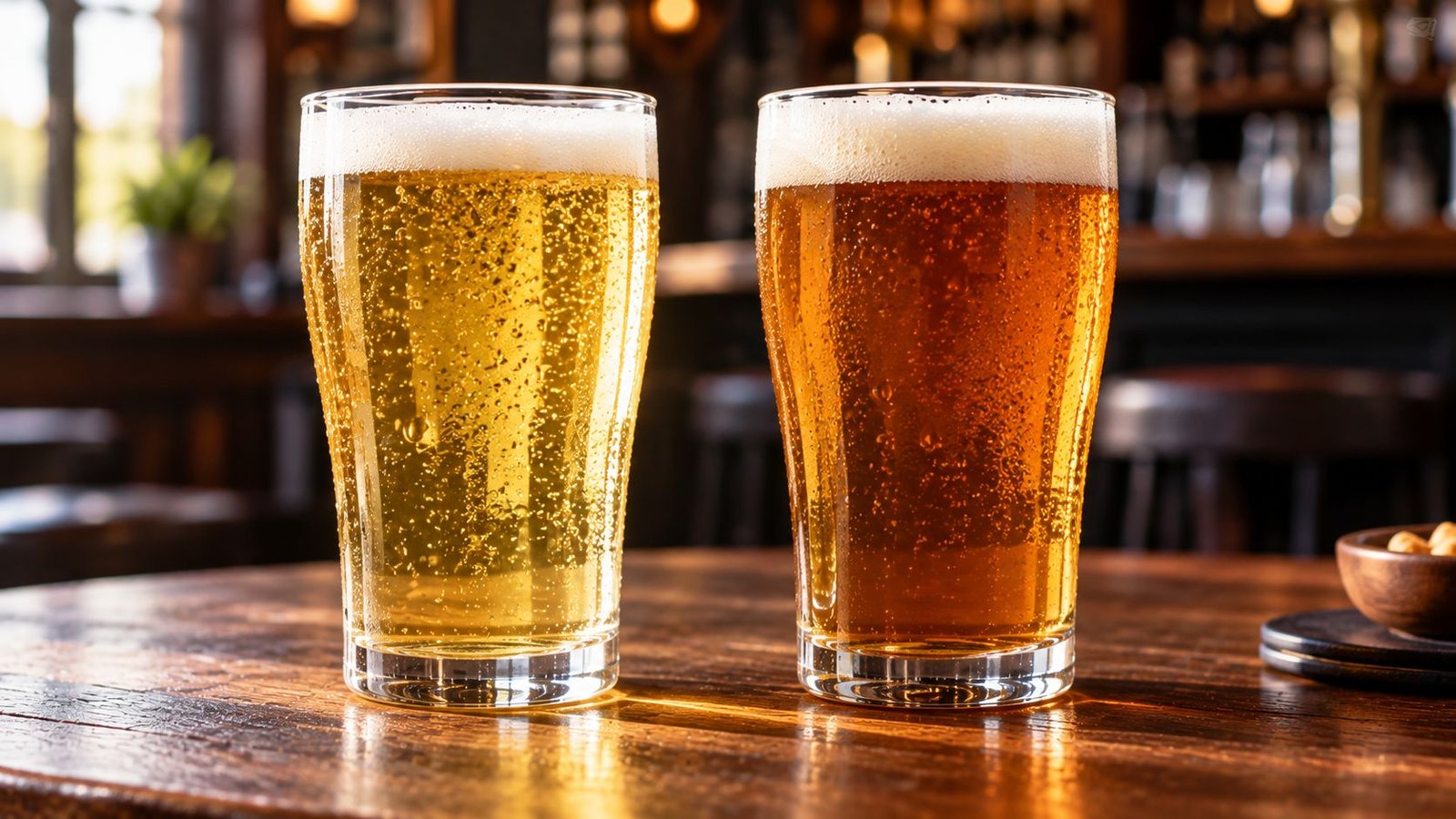


Light beer sounds like the sensible choice at the bar. Fewer calories, less alcohol, perhaps even a little hydration with your happy hour. The label practically arrives wearing running shoes.
But the light beer health benefits are more modest than marketing sometimes suggests. Choosing a lower-calorie, lower-ABV beer can reduce your alcohol and calorie intake compared with drinking the same amount of a stronger beer. That can be a useful trade if you already drink.
It does not, however, turn beer into a health drink.
Current guidance from the National Institute on Alcohol Abuse and Alcoholism says the overall relationship is straightforward: when it comes to alcohol and health, less is better. Even relatively low alcohol intake has been associated with health risks, including certain cancers.
So, is light beer better for you? In a narrow sense, often yes. In an absolute sense, water remains undefeated.
Key Takeaways
- Light beer generally contains fewer calories than regular beer.
- Some light beers contain less alcohol, but the difference may be smaller than you expect.
- Lower alcohol exposure is the most meaningful potential health advantage.
- Beer contains plenty of water, but alcoholic beer should not be treated as a hydration beverage.
- Light beer is not proven to improve heart health, prevent disease or provide a health advantage over not drinking.
Table of Contents
Is Light Beer Actually Better for You?

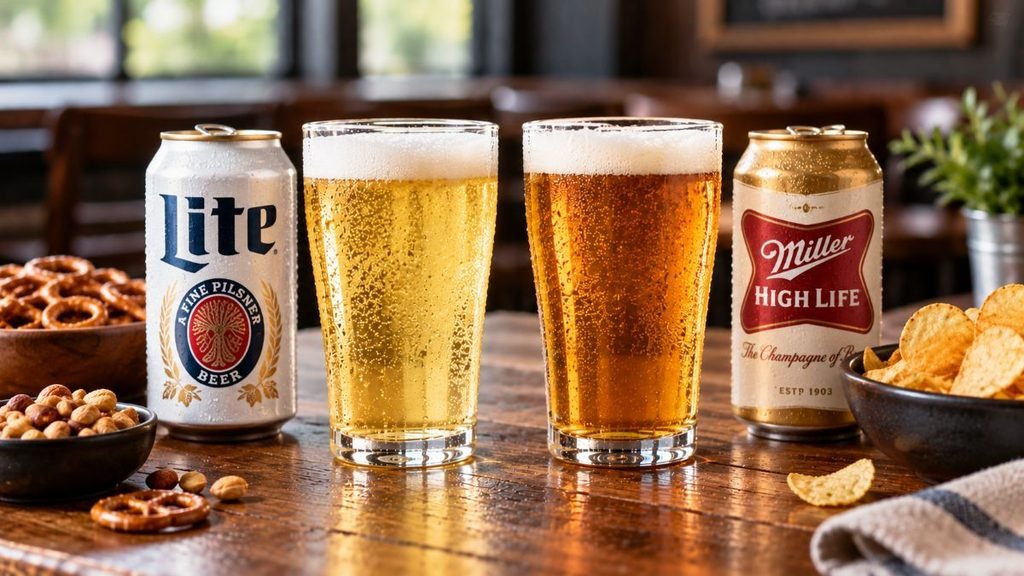
It can be less harmful than a stronger or higher-calorie beer when consumed in the same quantity, but that is different from calling it beneficial.
The distinction matters.
The CDC says drinking less alcohol reduces risk compared with drinking more, while also noting that even moderate drinking may carry more health risk than not drinking at all. People who do not drink are not advised to start drinking for health reasons.
That gives light beer its most defensible selling point: it can be one tool for reducing overall intake.
Just check the label first. “Light” does not automatically mean “very low alcohol.”
1. Light Beer Usually Has Fewer Calories
This is the easiest advantage to document.
A historical USDA dietary-guidelines comparison put a 12-ounce regular beer at about 153 calories and a light beer at about 103 calories. Exact numbers vary by brand, recipe and alcohol content, so the can in your hand is more useful than any universal average.
Much of beer’s calorie load comes from alcohol itself. Ethanol provides roughly 7 calories per gram, in addition to calories contributed by carbohydrates and other components of the drink.
If you replace a 150-calorie beer with a 100-calorie beer, you save roughly 50 calories.
Have one beer and the difference is small. Repeat that swap regularly and the numbers become more meaningful.
That is an advantage for calorie management, not a metabolism hack.
2. Some Light Beers Deliver Less Alcohol
Lower alcohol intake matters much more than shaving 40 or 50 calories off a drink.
But here comes the fine print: light beer is not necessarily low-alcohol beer.
NIAAA notes that many light beers contain about 85% as much alcohol as regular beer. It gives a typical comparison of about 4.2% ABV for some light beers versus 5% for regular beer. NIAAA separately reports a mean of roughly 4.3% ABV for light beers.
That reduction is real, but modest.
A 12-ounce beer at 4.2% ABV contains about 0.8 U.S. standard drinks, while 12 ounces at 5% represents approximately one standard drink.
The practical lesson: shop by ABV, not by adjectives.
“Light,” “crisp,” “easy-drinking,” and “refreshing” tell you considerably less than the little percentage sign on the label.
3. Lower-ABV Beer Can Reduce Alcohol Exposure Per Serving
This is where the case for light beer becomes more substantial.
Alcohol itself—not whether it arrives in an IPA, lager, cocktail or expensive bottle of wine—is responsible for alcohol-related health risks. NIAAA reports that alcohol plays a causal role in more than 200 diseases, injuries and other health conditions.
The World Health Organization likewise states that a completely risk-free threshold for alcohol and cancer cannot be established.
That means moving from a 7% IPA to a 4% lager can matter considerably more than moving from a 5% lager to a 4.2% light lager.
For anyone trying to moderate, the smarter comparison is therefore:
How much alcohol is in this serving?
Not:
Does the can say light?
Spice2Vice readers looking specifically for lower-strength options can also explore our guide to low-alcohol beers and our broader look at low-alcohol light beers.
4. A Lower-ABV Beer May Make Moderation Easier — If You Don’t Compensate
There is a simple mathematical advantage to choosing weaker beer.
Drink the same volume at a lower ABV and you ingest less ethanol.
The catch is behavioral. If “light” becomes permission to drink two beers instead of one, the advantage can disappear quickly.
For example, two 12-ounce beers at 4.2% ABV contain substantially more total alcohol than one 12-ounce beer at 5%.
This is why serving count still matters.
NIAAA emphasizes that beverage size and alcohol percentage must be considered together when calculating standard drinks. A bigger glass can erase the advantage of lower ABV just as easily as ordering another round.
5. Light Beer Contains Water, but Don’t Call It a Hydration Strategy
Here is one of beer culture’s more durable half-truths.
Beer is mostly water. Therefore, drinking one does contribute fluid.
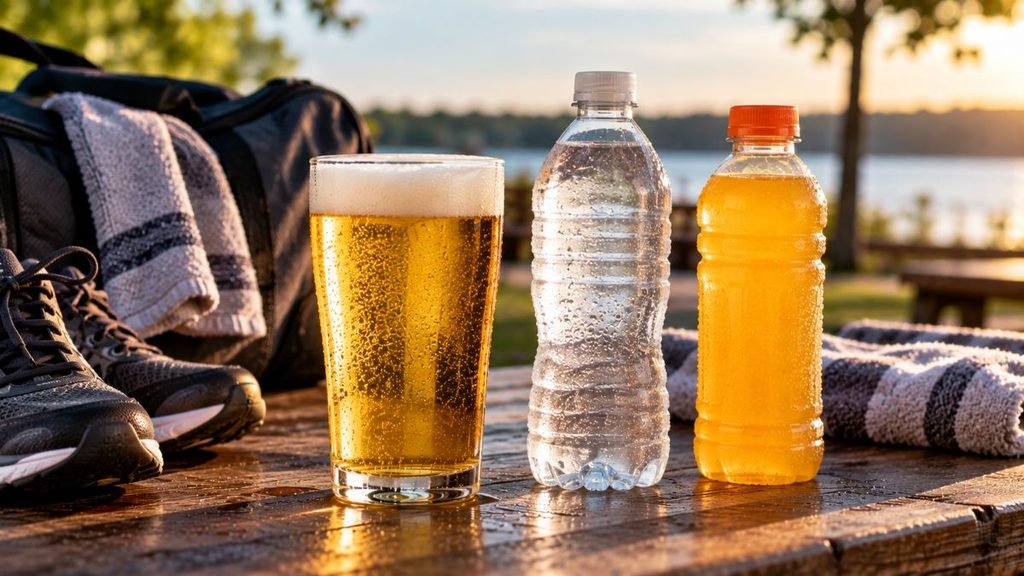
That does not make ordinary alcoholic beer the equivalent of water, an electrolyte drink or a sensible post-workout rehydration beverage.
Small exercise studies illustrate why the subject is more complicated than “alcohol dehydrates you.”
One study comparing water, low-alcohol beer and 4.6% beer after exercise found greater urine output with full-strength beer. Researchers also observed impaired balance with the alcoholic beer compared with water or low-alcohol beer.
Another trial comparing 0%, 2% and 5% beer with water and a sports drink found only limited differences in overall fluid balance, although full-strength beer performed worst for fluid retention and produced greater early urine output than the sports drink.
Other small studies suggest that alcohol’s diuretic effect changes with dose and a person’s starting hydration status.
Translation: beer does not instantly wring all the water out of your body, but ordinary alcoholic beer is still a poor choice when rehydration is the goal.
Drink water.
Save the pilsner for after you’ve found your water bottle.
6. Very Low-Alcohol Beer Performs Better in Hydration Studies
There is one interesting wrinkle.
Researchers studying post-exercise fluid replacement have found better fluid retention with very low-alcohol beer, particularly when sodium was added.
In one experiment, beer at 2.3% ABV with added sodium produced a better net fluid balance than full-strength 4.8% beer. A follow-up study suggested that sodium concentration mattered even more than relatively small changes in alcohol concentration.
That is scientifically interesting.
It is not a recommendation to fill your gym bottle with beer.
These were small controlled studies, largely involving young men after exercise. A specially formulated 2.3% beer with added electrolytes is also not equivalent to grabbing a mainstream light lager from the refrigerator.
For serious rehydration, water, food and appropriate electrolyte beverages remain much more straightforward tools.
7. Light Beer Can Be a Practical Step Toward Lower-ABV Drinking
Perhaps the strongest argument for light beer is cultural rather than medicinal.
It gives drinkers who enjoy the ritual and flavor of beer a way to lower alcohol exposure without necessarily giving up the experience altogether.
The difference becomes even more substantial when drinkers move beyond conventional light beer into genuinely low-ABV or nonalcoholic options.
That shift is already visible in the beer market. Spice2Vice has covered the growing nonalcoholic beer market, where breweries are increasingly competing for people who want beer flavor with little or no alcohol.
For anyone interested in moderation, a progression such as 7% IPA → 4% lager → 2% low-alcohol beer → 0.5% or alcohol-free beer reduces ethanol exposure much more dramatically than obsessing over whether one conventional light beer contains 95 calories and another contains 105.
What Light Beer Does Not Do

This is where some older health messaging needs an update.
It does not make alcohol good for your heart
You may remember headlines suggesting moderate alcohol consumption protects against heart disease.
Current public-health guidance is considerably more cautious.
The CDC says stronger research does not show that drinking about two drinks per day lowers overall mortality compared with not drinking. Moderate alcohol consumption may instead increase risks of chronic disease, including certain cancers and heart problems.
Choosing light beer therefore does not unlock some cardiovascular bonus round.
It does not cancel alcohol-related cancer risk
Lowering alcohol consumption can lower exposure, but a lower-ABV drink still contains ethanol unless it is genuinely alcohol-free.
WHO notes that ethanol in alcoholic beverages is carcinogenic and that no completely safe level for cancer risk has been established.
It does not guarantee weight loss
Lower-calorie beer can make reducing calorie intake easier.
It cannot compensate for drinking more servings, eating additional food while drinking or consuming excess calories elsewhere.
A 100-calorie beer is still 100 calories.
Nutrition remains annoyingly good at arithmetic.
Light Beer vs. Regular Beer: The Useful Comparison
| Factor | Light beer | Regular beer | What matters |
|---|---|---|---|
| Calories | Usually lower | Usually higher | Check individual labels |
| Alcohol | Often somewhat lower | Often around 5% ABV or higher | Compare ABV directly |
| Hydration | Provides fluid but contains alcohol | Provides fluid but usually more alcohol | Water is preferable |
| Health risk | Potentially lower if it reduces alcohol consumed | Potentially higher with greater ethanol intake | Total alcohol matters most |
| Weight management | Can reduce calories per serving | Typically contributes more calories | Number of servings still counts |
If you want to compare beer strength rather than marketing categories, Spice2Vice’s guide to beer alcohol content offers a useful next stop.
So, Is Light Beer Healthy?
No.
But that does not make the category pointless.
For an adult who already drinks beer, choosing a lower-calorie and genuinely lower-ABV option can reduce calorie and alcohol exposure compared with drinking the same volume of a stronger beer.
That is the real advantage.
Think of light beer as a moderation tool, not a wellness product.
And if reducing alcohol exposure is the objective, keep moving down the ABV scale. Today’s low-alcohol and nonalcoholic beers give drinkers far more room to do that without surrendering the beer experience entirely.
Because drinking smarter is considerably more useful than pretending a silver can counts as a multivitamin.
Responsible drinking: Alcohol carries health and impairment risks. Adults who drink should consider consuming less; people who do not drink should not start for health reasons. Do not drink before driving or operating machinery, during pregnancy, or when alcohol conflicts with medications or medical conditions.
FAQs – Light Beer Health Benefits
Is light beer healthier than regular beer?
Light beer can contain fewer calories and somewhat less alcohol than regular beer, making it a lower-exposure choice when serving sizes and number of drinks remain equal. It should not be considered a health-promoting beverage.
How many calories are in a light beer?
Calories vary by brand. Historical USDA guidance has used an average of about 103 calories for a 12-ounce light beer compared with roughly 153 calories for regular beer. Always check the current product label for exact numbers.
Does light beer have less alcohol?
Often, but not dramatically. NIAAA reports that light beers average around 4.3% ABV, compared with about 5% for a typical regular beer. Some products differ considerably, so check the ABV.
Does light beer hydrate you?
Beer contributes fluid because it contains water, but alcoholic beer is not an ideal hydration beverage. Research after exercise suggests higher-alcohol beer can increase urine production or reduce fluid retention compared with lower-alcohol alternatives.
Should I start drinking light beer for health benefits?
No. The CDC advises people who do not drink not to begin drinking for health reasons.
Sources
- National Institute on Alcohol Abuse and Alcoholism: What Is a Standard Drink?
- NIAAA: The Basics — Defining How Much Alcohol Is Too Much
- CDC: About Moderate Alcohol Use
- NIAAA: Alcohol and the Human Body
- World Health Organization: No Level of Alcohol Consumption Is Safe for Our Health
- PubMed: Postexercise Rehydration With Beer Impairs Fluid Retention, Reaction Time and Balance
- PubMed: Post-Exercise Rehydration and Beer With Varying Alcohol Content




One thought on “Light Beer Health Benefits – 7 Key Takeaways on What the Science Really Says”
Comments are closed.